
Subscribe!
If JFK Had Survived Nov. 22, 1963: We Asked Four AIs to Imagine 2026—and They Agree to Disagree
by RINewsToday team
On the 63rd anniversary of the assassination, RINewsToday put the same counterfactual question to ChatGPT, Gemini, Claude, and Perplexity. Their answers reveal a fascinating divide between algorithmic caution and hope.
In Newport, Rhode Island, the Kennedy story is etched into the coastline at Hammersmith Farm—the 28-room estate overlooking Narragansett Bay that served as John F. Kennedy’s “Summer White House” and where he and Jackie spent their 10th wedding anniversary just two months before Dallas.
Every November 22, historians and everyday Americans wonder how differently the world might have turned had the motorcade passed safely through Dealey Plaza. On the 63rd anniversary of the assassination, RINewsToday put that exact question to four leading artificial intelligence models—ChatGPT, Gemini, Claude, and Perplexity—to see how modern algorithms simulate an alternate 2026.
The experiment produced a striking consensus on the major turning points of the 1960s, alongside a sharp divide over whether surviving Dallas would have sparked a golden age of global cooperation—or simply traded one set of political crises for another.
Where the Algorithms Agree: A Smaller War and a Harder Domestic Fight
All four models pointed to Vietnam as the single greatest pivot point for modern life. Citing Kennedy’s October 1963 directive to bring home 1,000 U.S. military advisers by year’s end, every AI concluded JFK was far more likely than Lyndon B. Johnson to resist committing hundreds of thousands of ground combat troops in 1965.
For Perplexity, which anchors its answers in live web citations, the human toll of avoiding a full-scale war outweighed any geopolitical calculation: across Southeast Asia and the United States, it wrote, “more families grow old together.”
At home, however, all four models agreed that surviving Dallas wouldn’t have guaranteed smooth sailing. While the House Judiciary Committee advanced Kennedy’s civil rights bill just two days before his death, every AI noted that JFK lacked Johnson’s unmatched Senate arm-twisting—meaning landmark laws like the Civil Rights Act, the Voting Rights Act, and Medicare likely would have arrived more slowly, faced stiffer Southern filibusters, or passed in narrower forms.
How Four Different AIs “Think” About History
While all four systems drew from the same historical archive, their distinct training styles produced markedly different portraits of the decades that followed:
- ChatGPT (The Political Realist): ChatGPT focused tightly on secret decisions already in motion in November 1963—specifically White House backchannel talks with Fidel Castro’s government. Because Kennedy had already faced down Moscow during the Cuban Missile Crisis, ChatGPT noted he had unique political room to normalize relations with Havana decades early. Still, it refused to sugarcoat Southeast Asia, warning that avoiding ground troops might have meant “watching South Vietnam fall” years sooner.
- Perplexity (The Cautious Fact-Checker): Tethering its projections to existing 1963 treaties like the Limited Nuclear Test Ban, Perplexity balked at sci-fi leaps. While JFK had proposed a joint U.S.-Soviet Moon expedition at the United Nations in September 1963, Perplexity concluded an earlier version of the 1975 Apollo-Soyuz orbital docking was far more realistic than Americans and Soviets walking on the Moon together. Progress at home and abroad, it noted, “isn’t a straight line.”
- Claude (The Philosophical Skeptic): Claude pushed back hardest against romanticizing the Camelot era, reminding users of the hidden realities of Kennedy’s presidency—including his severe chronic back pain and Addison’s disease—alongside structural forces like urban unrest, 1970s oil shocks, and Soviet Premier Nikita Khrushchev’s 1964 ouster. Delivering the experiment’s sharpest reality check, Claude wrote: “History bends when leaders change, but rarely as far as nostalgia suggests.”
- Gemini (The Systemic Optimist): Gemini treated JFK’s survival as “a catalyst that prevents the worst fractures of the 1960s.” When pushed to imagine a “grounded optimistic utopia,” Gemini leaned into cascading domino effects: arguing that avoiding the financial and social bleed of Vietnam creates a massive “peace dividend” that redirects billions into clean energy, infrastructure, and a joint U.S.-Soviet Moon landing in July 1969—while sparing the nation the 1968 assassinations of Martin Luther King Jr. and Robert F. Kennedy.
What 2026 Looks Like Without Nov. 22
Ultimately, none of the four AI models imagined a 2026 filled with flying cars or futuristic gadgets. Instead, their simulations pointed to a quieter, profound difference in the American psyche today.
As Claude observed, simply processing the upheavals of the 1960s “without the shock of that day in Dallas… alone may have mattered more to the national mood than any single policy.”
In Perplexity’s words, the most hopeful plausible 2026 isn’t “Camelot preserved.” Rather, it is a modern world with “fewer empty chairs at family tables”—and enduring proof that nations can choose diplomacy “before catastrophe makes the choice for them.”
For Rhode Islanders: The “Summer White House” That Never Was: How JFK’s Survival Could Have Changed Newport’s Hammersmith Farm

President John F. Kennedy and First Lady Jacqueline Kennedy leaving St. Mary’s Church, Newport, Rhode Island, October 1961
From a private family retreat to a permanent presidential landmark, here is how Ocean State history might have unfolded.
If John F. Kennedy had returned from Dallas in November 1963, few places outside Washington, D.C., would have felt the ripple effects quite like Newport, Rhode Island.
Perching over Narragansett Bay at 225 Harrison Avenue, Hammersmith Farm—Jacqueline Bouvier Kennedy’s childhood summer home and the site of the couple’s famed 1953 wedding reception—had already earned its nickname as the “Summer White House.” From 1961 to 1963, the presidential flag flew above the 28-room shingle-style mansion as JFK signed legislation like the Peace Corps Act from its study, hosted foreign dignitaries, and sailed the bay aboard the presidential yacht Honey Fitz.
In September 1963—just two months before Dallas—the Kennedys spent their tenth wedding anniversary at the farm. Had JFK lived, historians and AI historical simulations point to several ways Newport’s history would have looked dramatically different:
- A Second-Term Diplomatic Hub: During the early 1960s, Kennedy hosted leaders like Indian Prime Minister Jawaharlal Nehru and Pakistani President Mohammad Ayub Khan in Newport. In an alternate second term focused on Cold War détente, Hammersmith Farm—with its sweeping ocean breezes and relative privacy—was poised to become an informal Camp David of the North, potentially hosting quiet summit talks with Soviet or European envoys away from Washington’s press corps.
- An Eerie Footnote from September 1963: During what turned out to be his final weekend at Hammersmith Farm in September 1963, JFK relaxed in the nautical-themed “Deck Room”—a spot he called the most beautiful site on the East Coast—and famously filmed a lighthearted, amateur spy spoof with family and friends in which he lay on the foyer floor covered in ketchup. Had he lived, that weekend would have been remembered simply as a joyful family recovery following the loss of their infant son, Patrick, rather than a poignant final goodbye.
- A Different Fate for the Estate: In our timeline, after JFK’s death and stepfather Hugh D. Auchincloss Jr.’s passing in 1976, Jackie’s mother, Janet Auchincloss, sold the main house and 54 acres in 1977. For two decades, Hammersmith Farm operated as a public museum before being purchased in the late 1990s by private owners—including former Goldman Sachs banker Peter Kiernan, who undertook a decade-long restoration to return it to a private family residence.
- The Alternate Preservation: Had JFK lived into his retirement years—and had Robert F. Kennedy never been assassinated in 1968—the Kennedys’ deep ties to Aquidneck Island would have spanned decades. Rather than falling into disrepair in the 1970s and 80s before private restoration, Hammersmith Farm could have remained an active hub of American political life through the 1980s, eventually transitioning into a federally protected presidential historic site much like the Kennedy Compound in Hyannis Port.
___
Sidebar: Who Uses Which AI?
-
- Market Reach: Holds roughly half of the global chatbot market with over 1.2 billion weekly users.
- Best Known For: Quick brainstorming, everyday writing, and personal advice—acting as the default digital assistant for general users.
-
- Market Reach: Reaches over a billion monthly app users, plus billions more through Google Search and Android devices.
- Best Known For: Seamless integration across Gmail, Google Docs, and mobile phones for students, families, and workplaces.
-
- Market Reach: The fastest-growing major U.S. chatbot app and a top choice for business software spending.
- Best Known For: Nuanced editorial writing, long-document analysis, and software coding—making it a favorite among journalists and engineers.
-
- Market Reach: Used by more than 45 million people each month looking for an alternative to traditional web search.
- Best Known For: Acting like a citation-driven research engine that attaches live web sources and footnotes to every answer.
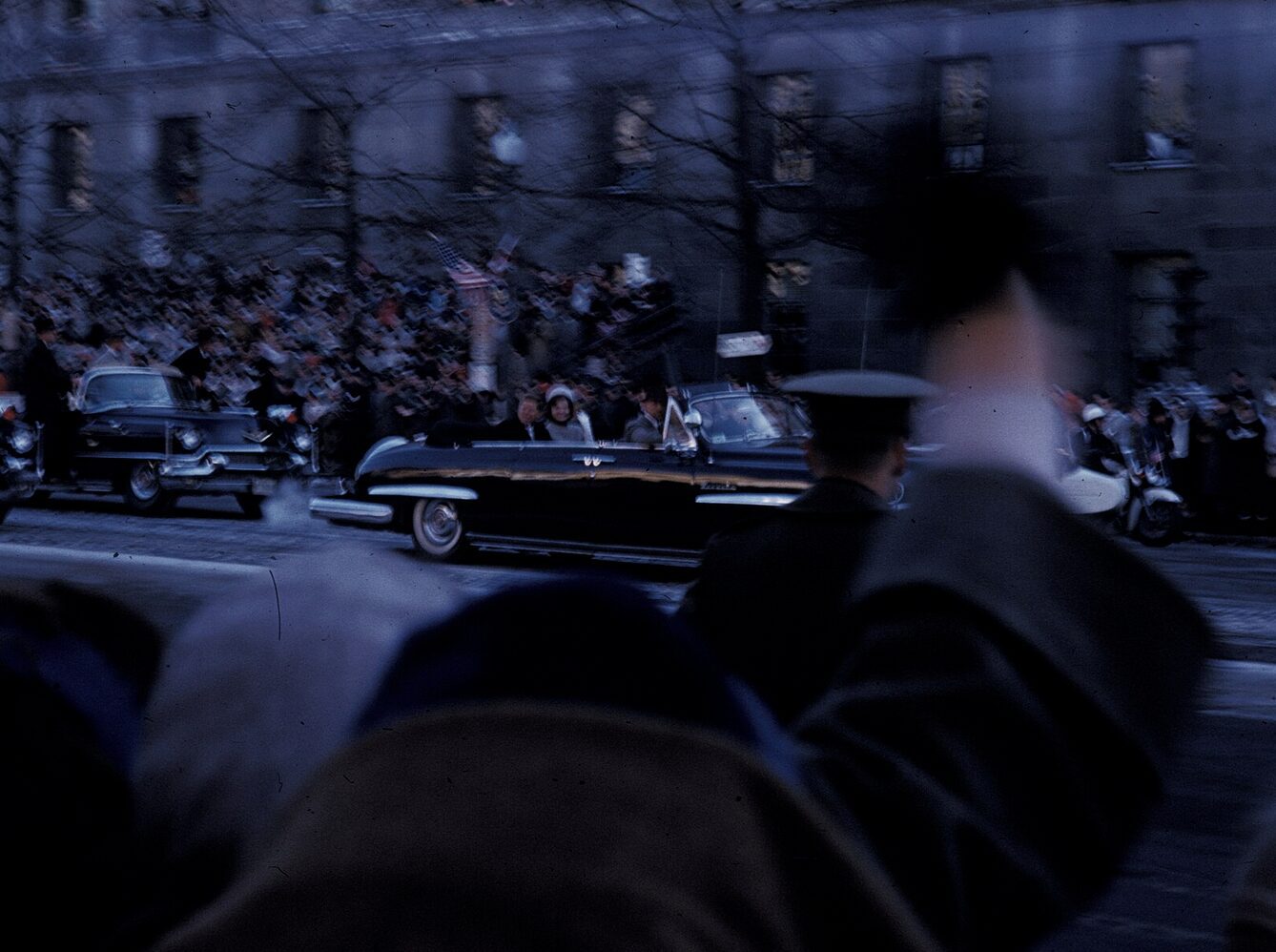
Photo, top: President John F. Kennedy and First Lady Jacqueline Kennedy wave from their convertible limousine during the inaugural parade in Washington, D.C., on January 20, 1961. (Photo: Gunther A. Helm / CC BY-SA 4.0)