
Subscribe!
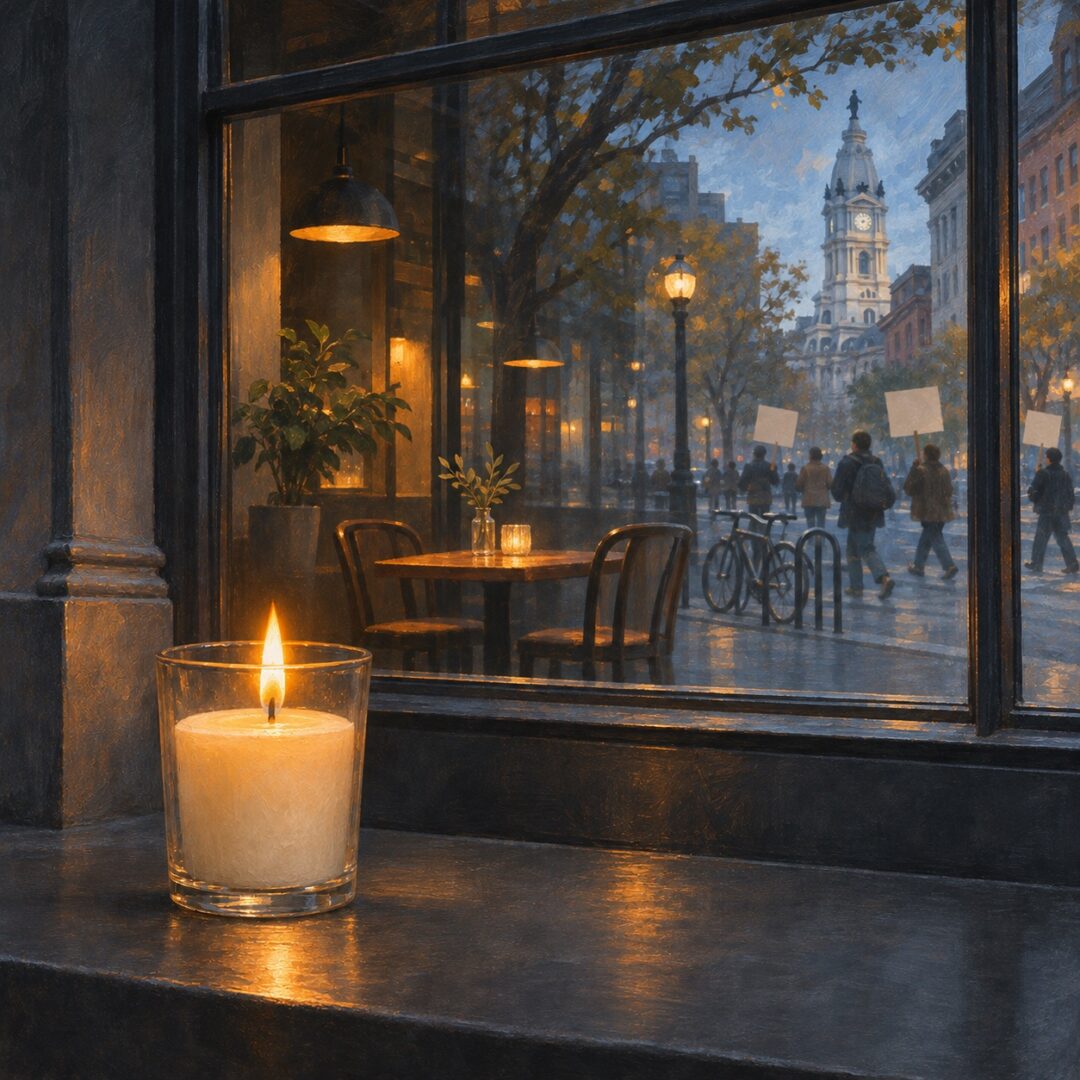
Kristallnacht Anniversary Bears Witness to Antisemitic Boycott of Philadelphia’s Jewish Businesses
Image: Philadelphia on Kristallnacht
by Nancy Thomas, contributing writer
Kristallnacht: The Night of Broken Glass, the Warning Signs—and Why We Remember
Eighty-eight years ago tonight, Jewish families watched their synagogues burn, their shops wrecked and their homes invaded. Men were taken away to concentration camps. The authorities who should have protected them helped carry out the persecution or allowed it to proceed.
The attacks of November 9–10, 1938, became known as Kristallnacht—the “Night of Broken Glass.”
Understanding what happened begins with the people behind those broken windows: shopkeepers, parents, children and neighbors whose country was systematically stripping away their safety, livelihoods and place in society.
What was Kristallnacht?
On the night of November 9–10, 1938, Nazi German leaders unleashed a nationwide anti-Jewish riot. The violence was supposed to look like an unplanned outburst of popular anger against Jews. In reality, this was state-sponsored vandalism, arson, and terror on Jewish communities throughout Nazi Germany, including annexed Austria and the Sudetenland region of what was then Czechoslovakia.
The name refers to the glass from shattered windows that littered the streets. Historians also call the attacks the November pogroms. A pogrom is a violent attack against a community, a term particularly associated with attacks on Jews.
According to the United States Holocaust Memorial Museum, Nazis burned more than 1,400 synagogues and vandalized thousands of Jewish businesses. They broke into homes, desecrated religious objects, humiliated residents and assaulted and killed Jewish people. Ordinary civilians joined Nazi organizations in the destruction.
Hundreds of Jews died during the violence and its aftermath. Tens of thousands of Jewish men were arrested; about 26,000 were imprisoned in concentration camps simply because they were Jewish.
The familiar phrase “Night of Broken Glass” can make the event sound primarily like property destruction. The Jewish Museum Berlin cautions that the name understates the violence against people. The terror also continued beyond a single night.
How did it happen?
Nazi leaders used the shooting of German diplomat Ernst vom Rath in Paris by Jewish teenager Herschel Grynszpan as a pretext. Vom Rath died on November 9. Nazi propaganda portrayed the ensuing attacks as spontaneous public outrage.
They were organized violence backed by the state with Police receiving orders not to stop the destruction. Firefighters allowed synagogues to burn. Families could not count on the institutions responsible for public safety to protect them.
Afterward, the Nazi regime imposed a collective fine of one billion Reichsmarks on Germany’s Jewish community. Jewish owners were required to repair damage inflicted by the attackers, while insurance payments were confiscated by the government. The victims were made to pay for their own persecution.
The warning signs came earlier
Kristallnacht followed years of exclusion.
On April 1, 1933, shortly after Adolf Hitler came to power, the Nazis organized a nationwide boycott of Jewish businesses and professionals. Uniformed storm troopers stood outside shops to intimidate customers. The campaign sought to drive Jews out of Germany’s economic life.
Some Germans ignored the boycott and continued shopping at Jewish businesses. Others participated or stayed away.
By November 1938, persecution had escalated into coordinated destruction, violence and mass imprisonment. Many Jewish families concluded there was no future for them in Germany and sought to leave.
Kristallnacht was a major escalation on the path to the Holocaust and the murdering of six million Jews. Remembering it means examining the steps that made such persecution possible—and the responses of people who witnessed them.
What are Rhode Island students taught in school?
Rhode Island has required Holocaust and genocide instruction in public schools since the 2017–18 school year. Every district must include a unit, with instruction occurring during middle school and/or high school as determined locally. The law sets no minimum number of teaching hours, does not require instruction every year and does not specifically name Kristallnacht.
The state’s high-school U.S. history standards call for students to explain the events and ideologies leading to the Holocaust and examine the development of Nazi policies. Kristallnacht fits directly within those objectives.
A requirement to teach the Holocaust does not, by itself, establish how thoroughly students learn about the boycotts, exclusion and escalating persecution that preceded mass murder. Determining that would require examining district curricula and classroom instruction.
The anniversary and Philadelphia
This year’s anniversary arrives amid outrage over a boycott targeting six Jewish-owned restaurants in Philadelphia.
Philly Bike On Your Left organized a bicycle boycott for Sunday, November 8, around Rittenhouse Square.” Its flyer named Huda, Mac Mart, K’Far Café, Goldie, Dizengoff and Schlesinger’s – declaring: “No business for Zionists” and “These Zionist establishments must go.”
The footage is difficult to watch. Around the seven-minute mark, the scene shifts to customers lining up to support the targeted businesses.
Sunday’s boycott ride brought physical clashes and arrests—but also lines of customers determined to support the Jewish-owned businesses being targeted. Police reported three arrests and minor injuries to two officers. No damage to surrounding properties was reported.
Customers lined up outside K’Far, Goldie and Mac Mart. Some traveled from outside Pennsylvania to show their support. At Schlesinger’s Deli, owner Allan Domb welcomed the community’s response.
Footage cited by The Times of Israel included a participant announcing that the bicycle ride had ended early because conditions were becoming dangerous. The boycott effort, however, may continue: organizers told 6abc another ride is planned for November 15.
Among the owners targeted was Huda chef Yehuda Sichel, a grandson of Holocaust survivors.
“I’m proud to be Jewish and supportive of Israel,” Sichel told JNS. “Neither should make my business a target.”
Who organized—and who supports—the boycott?
Philly Bike On Your Left describes itself as an anti-fascist, anti-Zionist cycling collective. It says it is demonstrating solidarity with Palestinians and challenging business owners’ support for Israel. Organizers reject accusations of antisemitism.
The Philadelphia Jewish Exponent identified Philly Writers Against the War on Gaza, Philly Solidarity Calendar and Boycott CookNSolo as collaborating groups. Boycott CookNSolo subsequently said it supported the ride but had not organized it.
A broader solidarity statement lists student, faculty, healthcare and community activist groups, including U Penn and Temple U faculty-and-staff groups and a Philadelphia Students for Justice in Palestine coalition. Those endorsements are from activist groups, not the universities themselves.
Support also extends beyond Pennsylvania. A November 7 statement attributed to NYC for Palestine Cycling Club, reproduced on activist photographer Javier Soriano’s website, expresses solidarity with the Philadelphia cyclists.
An unequivocal response
The Jewish Federation of Greater Philadelphia jointly condemned the campaign with ADL Philadelphia, American Jewish Committee Philadelphia/Southern New Jersey and StandWithUs.
“Let’s be clear: This is antisemitism. It is Jew-Hatred, plain and simple,” their statement declared.
The organizations called for elected officials to condemn the campaign, police to protect businesses and customers, and residents to support the restaurants. They distinguished criticism of Israeli government policies from targeting businesses because their owners are Jewish or perceived to have connections to Israel.
Their statement distinguished criticism of Israeli government policies from targeting owners because they are Jewish or perceived to have connections to Israel.
In a subsequent update, the Federation said it was working with the Secure Community Network, law enforcement and elected officials on safety. It urged residents to support the restaurants peacefully and avoid confrontations with protesters.
Gov. Josh Shapiro, Philadelphia Mayor Cherelle Parker and other officials condemned the targeting; Parker pledged protection for residents and businesses while safeguarding peaceful protest.
Showing up for the businesses
JewBelong placed billboards at 14 locations urging people to “boycott the boycott.” JewBelong is a New Jersey nonprofit founded in 2017 by marketing professionals Archie Gottesman and Stacy Stuart. Originally created to make Jewish traditions more accessible, it has become known for bright pink billboards confronting antisemitism.
Kristallnacht deserves to be remembered for the people terrorized, the lives lost and the state-directed persecution it represented. The events in Philadelphia are not equivalent to that violence. But the history of economic exclusion helps explain why calls to drive Jewish-owned businesses out of a community carry such weight.
While Kristallnacht was state-directed persecution, and the Philadelphia events are not equivalent to that violence, the history of economic exclusion explains why demands that Jewish-owned businesses “must go” carry such weight.
“Never Again” requires more than remembering where persecution ended. It requires recognizing and confronting how it began.