
Subscribe!
Ask Chef Walter: The Day of the Dead – Walter Potenza
by Chef Walter Potenza, contributing writer
Foods Popular During the Day of the Dead: Tradition and Symbolism.
Día de Los Muertos is Mexico’s bright, colorful way of remembering people who’ve passed away—and its way more about celebration than sadness. Instead of treating death like something dark and scary, families welcome the spirits of their loved ones back for a visit, share stories, put out favorite foods, and basically throw a party in their honor. It usually peaks on November 1 and 2 (All Saints’ and All Souls’ Days),though a lot of people start getting ready in late October.
November 1 is often for the kids who’ve died (the Angelitos), and November 2 is more for the adults. It’s mostly a Mexican tradition (and one Mexican community keep alive around the world), even though it overlaps with Catholic feast days. The real magic comes from mixing old Indigenous beliefs with Spanish Catholic ones.
Long before the Spanish showed up, people in Mesoamerica—especially the Aztecs and other Nahua groups—saw death as just another part of the cycle of life. They held festivals, left offerings of food and supplies, and believed spirits could come back at certain times of the year. After the conquest, the Church tried to fold those practices into All Saints and All Souls’ Days.
What stuck around is this beautiful hybrid we know today: part ancient ritual, part Catholic calendar, all about love and memory. The heart of the holiday is the ofrenda—a home altar stacked with photos, bright orange marigolds (said to guide the spirits home with their strong scent), candles, water, salt, cut-paper banners, and incense. And of course, food.
The dishes aren’t just snacks. Families put out the person’s favorite meals and traditional treats so the spirits can enjoy the smells and tastes they loved when they were alive. After the visit, the living dig in too. It’s a way of saying, “We still remember what made you happy.” Preparing the food also brings the family together and keeps those connections strong across generations.
The Classic Foods for the Holiday
Pan de Muerto
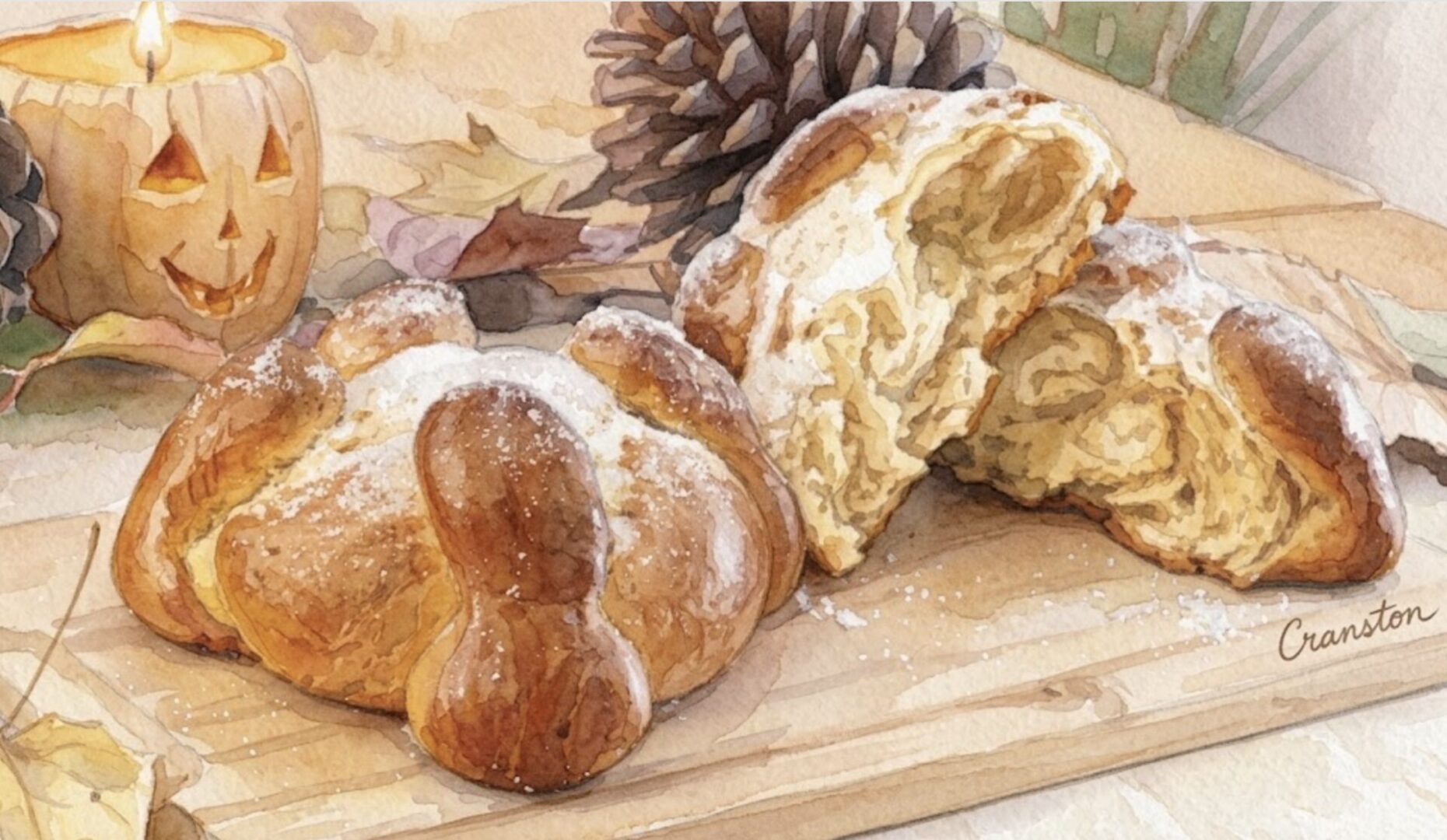
This soft, slightly sweet bread is basically the unofficial mascot of the holiday. It’s usually flavored with anise and orange, dusted with sugar, and decorated with dough strips that look like bones (plus a little ball on top that stands in for a skull). Families share it as a simple, meaningful way to remember the people they’ve lost. It goes perfectly with a warm drink.
Calaveras de Azucar (Sugar Skulls)
These colorful, decorated sugar skulls are pure personality. People often write a name across the forehead—sometimes someone who’s gone, sometimes just for fun. They’re more art than everyday candy, but they turn death into something bright and almost playful.
Mole
That rich, complicated sauce made with chilies, spices, nuts, and often a bit of chocolate is pure celebration food. Making good mole takes time and care, making it a fitting offering. It’s the kind of dish that feels special and layered—like life itself.
Atole (and Champurrado)
On a cool night, nothing beats a thick, warm cup of atole. It’s a corn-based drink flavored with cinnamon, vanilla, fruit, or chocolate (the champurrado version). Served with pan de Muerto, it’s comforting for the living and, according to tradition, welcome nourishment for the visiting spirits.
Tamales
These masa packages, filled with meat, cheese, chilies, or something sweet and wrapped in corn husks, appear on almost every ofrenda. Making a big batch is usually a group effort, which fits the holiday’s family-focused vibe. They’re practical, delicious, and meaningful—food meant to be shared between this world and the next.
You’ll also see seasonal fruit, candied pumpkin (calabaza en tacha), water for the journey, and whatever the person being remembered actually loved to eat or drink.
Why It Sticks With People
Día de Los Muertos takes Indigenous ideas about life and death, blends in Catholic timing, and turns it into something warm, personal, and full of flavor. The food isn’t just tradition for tradition’s sake—it’s a way to keep someone’s presence close, even after they’re gone. As the holiday has spread beyond Mexico, that core feeling hasn’t changed: remember the people you love, feed them (and yourself), and celebrate the fact that those connections don’t just disappear.
When I prepare Pan de Muerto, I take my time. I enjoy the simple pleasure of working the dough by hand, smelling the fresh citrus zest, and watching the yeast transform a humble mixture of flour, eggs, butter, and milk into something soft and alive. The finished bread, brushed with melted butter and dusted with sugar, has a delicate sweetness, a tender crumb, and a wonderful aroma of orange and anise.
My recipe for Pan de Muerto
Ingredients
For the dough:
4 cups (500 g) all-purpose flour, plus a little extra if needed
½ cup (100 g) granulated sugar
2¼ teaspoons (7 g) active dry yeast
½ cup (120 ml) warm milk
3 large eggs, at room temperature
½ cup (113 g) unsalted butter, softened
1 tablespoon finely grated orange zest
1 teaspoon vanilla extract
1 teaspoon anise seeds, lightly crushed
½ teaspoon salt
For the finishing touch:
2 tablespoons melted butter
¼ cup granulated sugar, approximately, for coating
There are plenty of methods, but this is how I make it
- I begin by waking up the yeast.
I pour the warm milk into a small bowl, stir in a teaspoon of the sugar, and sprinkle the yeast over the surface. I let it stand for about 5–10 minutes, until it becomes foamy. The milk should feel comfortably warm, never hot. This small step tells me the yeast is ready to do its work.
- I bring the flavors together.
In a large bowl, I combine the flour, remaining sugar, salt, anise seeds, and orange zest. I add the eggs, vanilla, and activated yeast mixture. I begin mixing until a rough dough forms. At this point, the dough may look a little uneven, but I don’t worry. It will come together as I work it.
- I knead patiently and add the butter.
I knead the dough for several minutes, then gradually work in the softened butter, a little at a time. It may become sticky before it turns smooth and elastic. I continue kneading for about 10–15 minutes by hand, or 8–10 minutes in a stand mixer fitted with a dough hook. I resist the temptation to add too much flour. A slightly tacky dough will usually produce a softer bread. When it feels supple and stretches without tearing too easily, I know I am getting close.
- I give the dough time to rise.
I place the dough in a lightly buttered bowl, cover it, and leave it in a warm, draft-free place for about 1½–2 hours, or until it has roughly doubled in size. I don’t rush this stage. Good bread needs time, and the dough will tell me when it is ready. While it rises, the kitchen gradually fills with the scent of orange and yeast. For me, that is one of the pleasures of baking: the anticipation is almost as satisfying as the first bite.
- I shape the traditional bread.
I gently press down the risen dough to release excess air and divide it, reserving a small portion for the decorations. I shape the main piece into a smooth, round loaf and place it on a parchment-lined baking sheet. With the reserved dough, I roll out thin strips and shape them into the familiar bone-like forms. I arrange two strips across the top of the loaf, often adding a small ball of dough at the center to represent a skull. These shapes are more than decoration. They connect the bread to the symbolism of Día de Los Muertos, a celebration in which food, family, memory, and cultural traditions come together.
- I let the shaped loaf rise again.
I cover the loaf loosely and allow it to rise for another 45–60 minutes, until it looks visibly puffy. This second rise helps create the light, tender texture I want.
Meanwhile, I preheat the oven to 350°F (175°C).
- I bake until the kitchen smells wonderful.
I bake the bread for approximately 25–35 minutes, depending on its size, until the crust is golden brown, and the loaf is cooked through. If the surface browns too quickly, I loosely cover it with foil during the final part of baking. I let it rest on a rack after removing it from the oven. The bread should feel light, and the crust should have a gentle golden color rather than becoming too dark.
- I finish it with butter and sugar.
While the bread is still slightly warm, I brush the entire surface with melted butter, taking care to cover the decorative bones as well. Then I sprinkle or gently roll the bread in granulated sugar until it has that familiar, delicate coating. I allow it to cool before slicing. I know it is tempting to cut into it immediately, but giving the crumb a little time to settle makes a difference.
My thoughts at the table
When I serve Pan de Muerto, I like to keep things simple. A cup of Mexican hot chocolate or good coffee is all I need. I tear off a piece, notice the softness of the crumb, and let the fragrance of orange and anise come through. What I appreciate most about this bread is that it reminds us that cooking is never just about technique. Across cultures, we use food to honor those who came before us, to gather families around a table, and to pass traditions from one generation to another.
Pan de Muerto is associated with Día de Los Muertos, observed on November 1 and 2, when many Mexican families honor deceased loved ones with ofrendas, photographs, flowers, candles, and foods their relatives enjoyed. The bread’s familiar shapes and symbolism can vary by region and family, but its place in this tradition is deeply meaningful.
I approach this recipe with respect for that heritage. I don’t see it simply as a sweet bread to bake for a seasonal occasion. I see it as an invitation to pause, remember, and share something made by hand.
And that, to me, is one of the most enduring lessons of cooking: we may lose the people we love, but the flavors, gestures, and traditions we share with them can remain at our table for generations.
https://flavorsandknowledge.substack.com/
___
READ “Ask Chef Walter” every Sunday in RINewsToday

Master Chef Walter Potenza
There is a constant, recognizable thread in the career of Walter Potenza to elevate the level of Italian culinary culture in the United States. Besides his unquestionable culinary talent and winning business perspective, Chef Walter has been a relentless educator with passion and knowledge who defeats stereotypes. His life, career, and values are a model, an example to follow by any chef of Italian gastronomy working outside Italy.
Chef Walter appears regularly on National and International Networks such as Food Network, ABC, CBS, NBC, RAI, FOX, and Publications such as NY. Times, Washington Post, Wall Street Journal, Food & Wine, Saveur, Gourmet, and several Italian media outlets.