
Subscribe!

RIPEC Report: Falling RI Unemployment, Strong Consumer Demand, Shrinking Workforce
| Rhode Island’s unemployment rate fell to its lowest level in nearly three years in the third quarter of 2026, according to the Rhode Island Key Performance Indicators (KPI) Quarterly Briefing released today by the Center for Global and Regional Economic Studies at Bryant University and the Rhode Island Public Expenditure Council (RIPEC).
However, the improvement came from people leaving the labor force rather than from more Rhode Islanders working. At the same time, in-state jobs held steady and consumer demand—as measured by net sales tax receipts—remained strong. “The Q3 2026 data reaffirm the cautious economic outlook observed in the previous quarter. While an unemployment rate of 3.7% is good news, it continues to mask a deeper structural concern: the decline is driven by people leaving the labor force,” remarked Edinaldo Tebaldi, Professor of Economics and Vice President of Strategy at Bryant. “Despite resilient consumer demand and stable nonfarm employment, resident employment declined for a fifth consecutive quarter and labor force participation declined for nine straight quarters; hence, the health of the labor market remains under significant pressure.” |
|
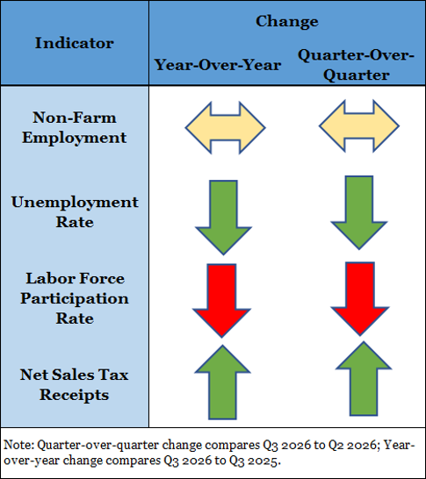
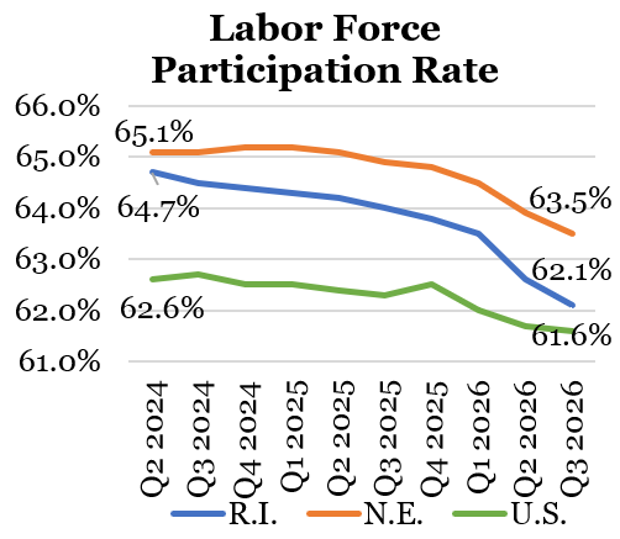
| Rhode Island’s unemployment rate fell for a second consecutive quarter, from 4.3% to 3.7% in Q3 2026, its lowest level since Q4 2023, and below both New England (4.2%) and the U.S. (4.1%). Even so, resident employmentdecreased for a fifth consecutive quarter, declining by 500 (-0.1%) to its lowest level in nearly five years. Declines in both unemployment and employment reflect a shrinking labor force, as Rhode Island’s labor force participation rate fell to 62.1% in Q3. This marked the ninth consecutive quarterly decline since participation peaked at 64.7% in Q2 2024. Over that period, Rhode Island’s rate fell by 2.6 percentage points, outpacing decreases in New England (-1.6 percentage points) and the U.S. (-1.0 percentage points). |
|
| Net sales tax receipts, a key indicator of aggregate demand, showed strong growth, increasing 7.5% year over year and 3.3% quarter over quarter (seasonally adjusted).
After contracting in Q1 2026, Rhode Island’s Gross Domestic Product (GDP) grew at an annualized rate of 0.9% in Q2, the most recent quarter for which data are available. Rhode Island’s GDP growth for Q2 trailed New England (2.5%) and the U.S. (2.2%), but the return to growth, together with resilient consumer spending, shows that the state is not in a recession, despite structural labor force headwinds. The number of Rhode Island-based jobs, or nonfarm employment, was steady in Q3 2026, rising by 400 (0.1%) quarter over quarter but falling by 500 (-0.1%) year over year. Rhode Island gained jobs in three of nine major industry sectors in Q3 2026, lost jobs in three, and saw essentially no change in the remaining three. Professional and business services posted the largest quarterly gain (+700 jobs), while education and health services, the state’s largest sector, recorded the largest decline (-900 jobs). “Some of this quarter’s indicators are encouraging, including continued growth in consumer spending and a steady number of in-state jobs, but others suggest that Rhode Island continues to fall behind the region and the nation,” said Michael DiBiase, President and CEO of RIPEC. “Our economy grew more slowly than New England’s and the country’s in the second quarter, extending a long-running trend, and our labor force is shrinking at a faster rate. Addressing these headwinds should be a priority for lawmakers, with a focus on building a more competitive business climate and a more highly skilled workforce.” The Briefing is available here. The data set used to create the Briefing is available here. |